Flea and Tick Prevention for Dogs and Cats: How Often, Which Kind, and Why Year-Round
Fleas and ticks are more than itchy pests. They spread tapeworms, Lyme disease and other infections, and a small flea problem can become a home infestation in weeks. The fix is simple: the right preventive, given on time, all year. Here is how often to give flea and tick prevention to dogs and cats, which kind to choose, and how to never miss a dose.
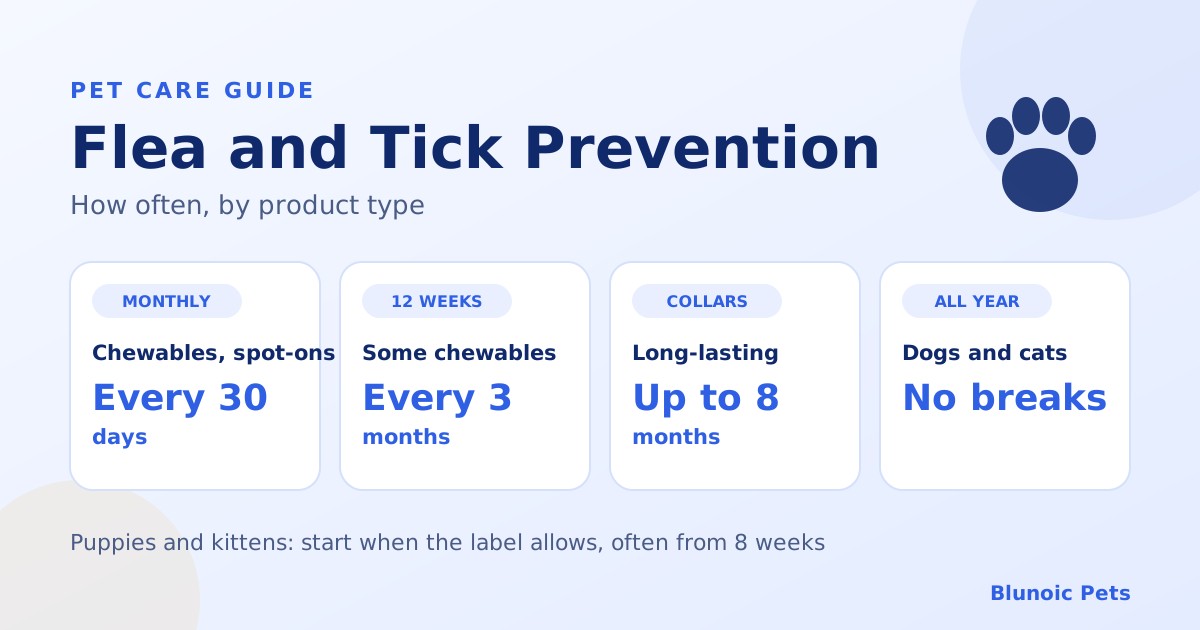
Common dosing intervals. Always follow the product label and your veterinarian’s advice for your pet’s age, weight and health.
Why flea and tick prevention matters
Fleas bite, cause itching and allergies, and carry tapeworms. One female flea can lay dozens of eggs a day, which drop into carpets, bedding and sofas, so a few fleas quickly turn into an infestation. Ticks spread diseases such as Lyme disease, ehrlichiosis and anaplasmosis in dogs, and can make cats ill too.
Indoor pets are not safe by default. Fleas come in on people, other pets and visitors, and ticks can ride in on clothing. That is why most vets recommend year-round flea and tick prevention rather than treating only in summer.
How often to give flea and tick prevention
How often depends on the product. Guidance such as the Companion Animal Parasite Council (CAPC) recommends protecting dogs and cats all year round.
| Product type | How often | Notes |
|---|---|---|
| Monthly chewable or tablet | Every month | The most common choice for dogs. Some also cover heartworm and intestinal worms. |
| Monthly spot-on (topical) | Every month | Applied to the skin at the back of the neck. Popular for cats. |
| Long-acting chewable | About every 12 weeks | Some dog and cat products last around 3 months. Mark the date, it’s easy to forget. |
| Flea and tick collar | Replace every few months, up to about 8 | Check the fit weekly and replace on time or after heavy swimming if the label says so. |
| New pet or active infestation | Start now, treat every pet | Treat all dogs and cats in the home at the same time and clean bedding and floors. |
Types of flea and tick prevention
- Oral chewables and tablets: easy to give, no greasy spot, and not affected by bathing or swimming. Many work for 1 or 3 months.
- Spot-on treatments: a small liquid dose on the skin. Keep children and other pets from touching the spot until it dries.
- Collars: long-lasting and good for busy families. Make sure two fingers fit under the collar.
- Combination products: some cover fleas, ticks, heartworm and intestinal worms in one dose. Ask your vet what each product does and does not cover.
- Shampoos and sprays: kill fleas on the pet today, but don’t protect for weeks. Use them alongside a real preventive, not instead of one.
When puppies and kittens can start
Many flea and tick products are labelled from 8 weeks of age and a minimum weight, and some start later. Very young puppies and kittens need gentle options chosen by your vet. Dose by your pet’s current weight, because young animals grow fast.
Important safety rule for cats
Never use a dog flea product on a cat. Many dog spot-ons contain permethrin, which is highly toxic to cats, even in small amounts or from close contact with a recently treated dog. Use only products made for cats, at the right weight.
Signs of fleas and ticks
- Scratching, biting or licking, especially at the base of the tail
- Tiny dark specks in the coat (“flea dirt”) that turn red on a wet paper towel
- Hair loss, scabs or red, irritated skin
- Rice-like tapeworm segments near the tail
- A small bump that grows over days on the head, ears, neck or between the toes: often a tick
To remove a tick, grip it close to the skin with fine tweezers or a tick tool and pull straight out slowly. Then watch your pet for a few weeks for fever, lameness or low energy, and call your vet if anything changes.
Tips for a routine that works
- Give prevention on the same day every month, and treat every pet in the home.
- Keep going in winter. Fleas live indoors all year and ticks are active whenever it’s above freezing.
- Wash pet bedding often and vacuum carpets and sofas during any flea problem.
- Write down the date, product and weight each time, so you know exactly when the next dose is due.
Keep track with Blunoic Pets
Monthly doses are easy to forget, and 12-week products are even easier. Blunoic Pets keeps track for every dog and cat in your home.
Blunoic Pets is free on Google Play for Android. The iPhone app is coming soon.
Frequently asked questions
How often should I give my dog flea and tick prevention?
Most products are given every month. Some chewables last about 12 weeks and some collars last up to about 8 months. Follow the label and give it all year round.
How often should I give my cat flea treatment?
Most cat flea treatments are monthly spot-ons, and some last up to 12 weeks. Indoor cats still need flea prevention, because fleas come in on people and other pets.
Do dogs and cats need flea and tick prevention in winter?
Yes. Fleas live indoors all year and ticks are active whenever temperatures are above freezing, so vets recommend year-round prevention.
When can puppies and kittens start flea treatment?
Many products are labelled from 8 weeks of age and a minimum weight, and some start later. Ask your vet which product is safe for your puppy or kitten.
Can I use dog flea treatment on my cat?
No. Many dog flea products contain permethrin, which is toxic to cats. Only use products made for cats, at the correct weight.
What are the signs my pet has fleas?
Scratching, biting at the skin, flea dirt (dark specks that turn red on a wet towel), hair loss, scabs, and tapeworm segments near the tail.
What is the best flea and tick prevention for dogs?
The best one is the product your vet recommends for your dog’s age, weight, health and local risks, given on time. Chewables, spot-ons and collars all work when used correctly.
How do I remember my pet’s next flea and tick dose?
Use a pet medication reminder app. In Blunoic Pets you add flea and tick prevention to your pet’s care plan and get a reminder before every dose.
Is there a pet medication reminder app for flea and tick doses?
Yes. Blunoic Pets plans flea and tick prevention in each pet’s care plan and reminds you before every monthly or 12-week dose.
About Blunoic Pets: Blunoic Pets is a free pet care tracker app and pet care schedule app for dogs and cats. It plans preventive care, works as a pet vaccine tracker and pet medication reminder app, and keeps digital pet records and health records for every pet in one account, so it is also a multi-pet tracker. Your family and pet sitters can share care in the same app, and the daily routine works as a puppy potty tracker and a dog feeding and walk tracker, with weight trends for every pet. Free on Google Play and the web; the iPhone app is coming soon.
Important: This guide is general information, not veterinary advice. The right flea and tick product and schedule depend on your pet’s species, age, weight, health and local parasites. Always follow your veterinarian’s advice and the product label.